Ad format
One person, one room, no cutaways: the Yapper ad format
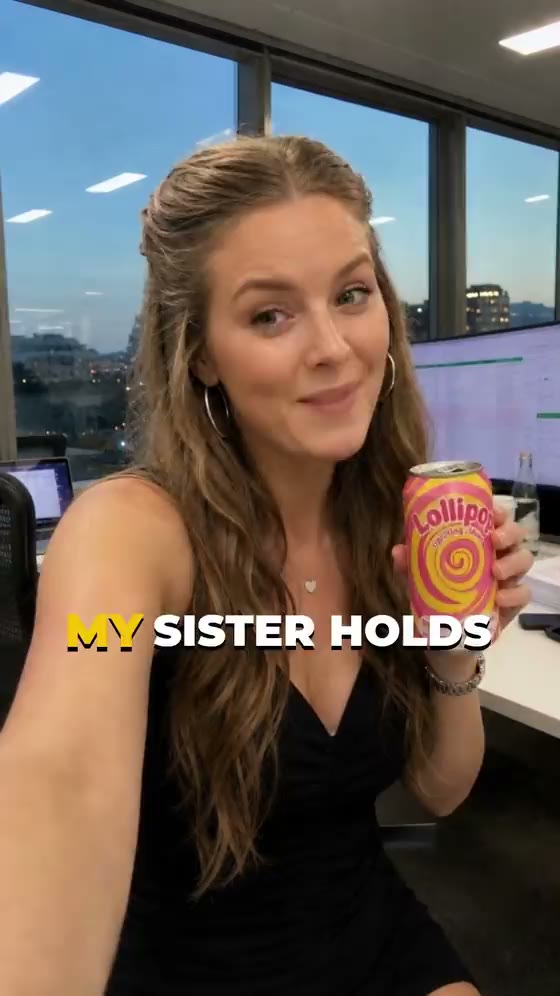
Yapper is a talking-head UGC ad format. One person speaks to camera in every single frame: no cutaways, no product inserts, no graphics, no B-roll of any kind. The whole ad is one performer in one real room, retelling an experience the way they would tell a friend. Lollipop generates it vertically, at 15, 20, 30 or 45 seconds, 20 by default.
When should you use the Yapper format?
Use Yapper when the product benefits from a trusted-peer recommendation and the buyer needs to see a real person’s face say it. Every selling point lands inside a story with characters and dialogue rather than being read off a list, which is what separates this from a voiceover-led format.
It suits claims that a person can be believed about: how something felt, what it replaced, why they stopped using the old thing. The performance is the evidence.
When is Yapper the wrong format?
Avoid Yapper when the claim only becomes believable once it is demonstrated. This format is all A-roll and never cuts away, so there is no frame in which the product can be shown working. If the ad needs a screen recording, a before-and-after, or a shot of the thing in use, the format cannot supply one and the script will strain against that.
Two more limits worth knowing before you pick it:
- No on-screen text. Yapper’s rules set the text-overlay policy to off and emit an empty overlay on every scene. The talking head is the message. The single admissible exception is a closing CTA or offer card when a brief explicitly demands one.
- Nothing about the performer can change. Hair, wardrobe, makeup and jewellery are locked for the whole ad, because it is meant to read as one sitting. There is no costume change, no second location, and no second person.
How does Yapper differ from the other talking-head formats?
Four other formats in the library also put a person on camera. The difference is what happens when they stop being the only thing on screen.
| Format | Who is on camera | B-roll | Authored on-screen text |
|---|---|---|---|
| Yapper | One person, every frame | None at all | Off, bar one closing card if a brief demands it |
| UGC with B-Rolls | One person, intercut | Proves each claim as it is spoken | Sparing, and only on a proof cutaway |
| UGC Story | One creator, narrating over themselves | The same creator living their day | Minimal; her voice is the copy |
| Expert Talking Head | A broadcast-grade presenter | High-end proof footage | Yes, and it is a signature of the format |
| UGC Voiceover | Nobody speaks to camera | The whole picture is B-roll | Essentially off |
What does Lollipop actually fix when you pick Yapper?
A format here is not a template with slots. Picking Yapper constrains every stage of generation, and the constraints are the format:
The room
Exactly one real, lived-in room for the whole ad, and the same room in every shot: a bedroom, a kitchen, a car seat, a bathroom mirror. Light comes from a single practical source so exposure is uneven and one side of the face falls off. A studio backdrop, a cyclorama, softbox arrays, rim light, ring-light catchlights or colour-graded haze are all forbidden. If the frame looks lit by a crew, the format has failed.
The performer
Framed chest-up to waist-up with eyes at lens height and both hands visible and empty. The identity portrait has to be mouth-forward, with the full mouth and jaw unobstructed, because the video model drives the speaking mouth off that image and anything covering it corrupts every shot. Wardrobe is one everyday outfit a real person would own.
The cutting
Framing size is the only cut available. Shots jump between extreme close-up, wide and medium close-up so the performer visibly grows and shrinks, and no size repeats on consecutive shots. The camera is held still: handheld micro-shake and an off-level horizon are fine, push-ins, gimbal glides and dollies are not. Cuts are jump cuts, match cuts on a gesture, or whips as she reframes herself. No dissolves, fades or wipes. The first frame is mid-action, never someone settling in to start.
How long should a Yapper ad be?
Yapper’s default length is 20 seconds, and its allowed lengths are 15, 20, 30 and 45.
Scripts are written to about three spoken words per second, so a format’s length is also its word budget: at the 20-second default that is roughly sixty spoken words. It is a useful sanity check on a brief. If the message will not fit in sixty words, either the ad is longer or the format is wrong.
The short default follows from having no B-roll. There is no second layer of picture to fill time with, so a long Yapper is only a longer monologue.
Where Yapper sits in the wider library
Yapper is one of six formats in the UGC family, and UGC is one of six families in Lollipop. The closest neighbours are the four in the table above. If you know you need proof on screen, start with UGC with B-Rolls instead.
Two formats in the catalogue solve the problem Yapper cannot. When the product has to be shown working rather than described, a whiteboard explainer draws the mechanism out one mark at a time with nobody on camera. And when one voice is not enough proof, the street interview format stacks several strangers agreeing back to back, which is a different argument from a single trusted face.
The same argument, made by somebody the viewer is meant to believe because of who they are rather than because they sound like a friend, is a different format and a deliberately unscrappy one: the crew-lit expert talking head, cut against proof.
If the question underneath is which tool rather than which format, four AI ad tools compared from their own published pages covers what each one is built on. All three of HeyGen’s video engines need an avatar identity plus a script or audio, so there is no model for generating arbitrary footage and no B-roll generation, which is a different way of putting one person on camera than generating the shot.
Start a Yapper ad now.
Make a Yapper adDescribe the product in a chat. Lollipop writes the script, casts the actor and renders every shot, and you can open the canvas to change any of it.