Ad format
A voice, a marker, and a board that fills the whole screen
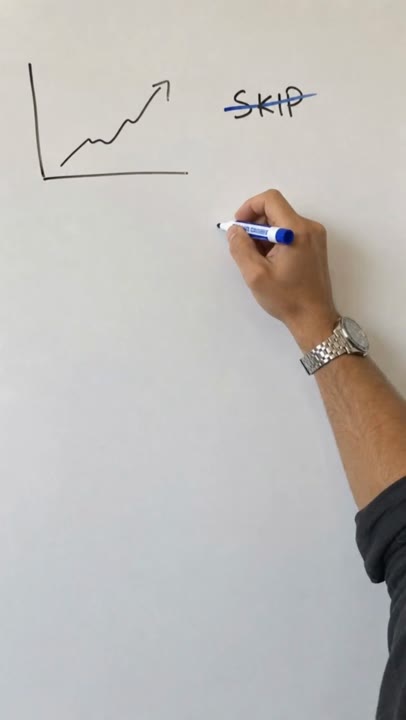
Whiteboard Explainer is Lollipop’s faceless argument format. A voice does the selling while one hand races to draw the idea on a stark white board. The board is not an object standing in a room: it fills the frame edge to edge, and nothing else is ever in shot except the host’s drawing hand and forearm.
When is a whiteboard explainer the right format?
Reach for it when the pitch is an argument. The format is built around one contrast, the bad old way against the better new way, for a buyer who needs to follow reasoning rather than trust a face. The racing hand keeps the eye busy while the voice does the work.
Its own definition is equally clear about when to walk away. Avoid it when the product sells on desire, texture, or somebody’s credibility, because nothing in a whiteboard ad is ever photographed. The product appears as a line drawing or it does not appear.
What the board is, and what it is not
The environment is a surface, not a place. Lollipop authors it as a flat scan of a board, shot dead-on, with no wall, no floor, no easel, no marker tray and no furniture anywhere in frame. Lighting is even and flat across the whole surface, because a directional key implies a light source, and a light source implies a room.
A blank board is correct here. That is worth saying plainly, because it reverses the usual instinct: elsewhere an empty frame reads as sterile and gets props added, and on a whiteboard the emptiness is the format.
The hand is the whole cast
Only one person is ever in a board shot, and only their forearm. The rules pin the sleeve, the cuff position, the skin tone, the nails and any watch, then repeat that description on every scene, because an unspecified sleeve gets reinvented shot to shot. A bare arm in the hook comes back as a grey long sleeve by the closing card.
How does a whiteboard scene actually get generated?
This is the part that makes the format unlike anything else in the catalogue. Each scene is generated as a pair of board images, one before a mark and one after it, and the video model only interpolates between them. The new ink is the video.
The failure that follows is specific and quiet. If the start frame already shows the finished drawing, there is nothing to interpolate. Both images generate cleanly, the video generates cleanly, and the clip plays its full length with a hand twitching over a board that never changes. Nothing errors. Lollipop’s rules for this format exist largely to prevent that one thing.
The words on the board come from the image model, not the video model. Any text that has to be readable is spelled out completely in the after frame, and the video model is only ever asked to reveal writing that already exists. Asking a video model to invent letters is how a board ends up carrying a word that is not a word.
Two builds, and you pick one
There is always a host, because somebody’s hand is drawing. What changes is whether you ever see their face. The presenter-led build puts them on camera for a minority of shots, usually the opener and the ask, and lets the board carry the middle. The pure whiteboard build never shows them at all.
How long is a whiteboard ad?
The default length is 30 seconds, and the allowed lengths are 30, 45, 60 and 90.
Scripts are written to about three spoken words per second, so a format’s length is also its word budget: at the 30-second default that is roughly ninety spoken words. Use it as a sanity check on a brief. An argument that needs two contrasts to land will not fit in ninety words, and the honest fix is a longer ad rather than a faster read.
Where it sits next to the other voice-led formats
Faceless is one of six families in the catalogue, and several formats outside it also run on a voice with no presenter. What separates them is what the picture is made of, and whether the format lets you write on it.
Make one of these for your own product.
Make a whiteboard adEvery new account starts with 4,000 credits.
| Format | What the picture is | Who is heard | Authored on-screen text |
|---|---|---|---|
| Whiteboard Explainer | One flat marker board, drawn on as you watch | A host whose face you may never see | None authored; the marker ink is the writing |
| POV Unboxing | First-person hands opening a sealed box | Nobody. The format is silent | Sparse: at most a hook line and a closing line |
| VSL (Video Sales Letter) | Renders, graphs, room footage, product macros | A narrator who is never on camera | Mandatory on the hook and on the CTA |
| UGC Voiceover | One performer living their day without speaking | That same performer, in voiceover | Essentially off |
| Voiceover Product Demo | Full-frame footage of the real product | A narrator who is never on camera | On generated shots only |
The limits, stated plainly
- Nothing is photographed. There is no shot in which your actual product can be seen. If the buyer needs to look at the thing, this format cannot show it to them.
- One mark per scene. A beat that wants a stick figure and an arrow and a labelled box is three scenes, not one. Fading half a page of ink into a four-second clip reads as a pop-in rather than as drawing.
- No authored text overlays. No lower third, no CTA card, no kinetic typography. A burned-in overlay would land on a frame that is already covered in handwriting and compete with the ink for the same job.
Picking between this and the neighbours
A format in Lollipop is a rule set rather than a template with slots. Each of the 21 formats ships its own scripting agent, its own scene agent and its own visual rules. Choosing one constrains every stage of generation, so the choice is worth making on the argument you have rather than on the picture you like.
If you want the same voice-led argument but need real footage, graphs and hard numbers on screen, read how the VSL format builds a proof reel under a narrator. If the sell depends on personality rather than reasoning, the opposite end of the catalogue is the Yapper talking-head format, which never cuts away from a face. And when the charm of a handmade object would carry the idea further than a diagram, claymation puts a sculpted puppet in the frame instead.
A board can draw an argument about software but it cannot show the software. When the proof has to be the screen itself, the presenter-led demo plays your own recording under a person making the case.
A board is often reached for when there is nothing physical to film at all, which is the normal case in software. What an ad generator is allowed to show of your software works backwards from that constraint rather than forwards from the catalogue.
Start a Whiteboard Explainer ad now.
Make a whiteboard adDescribe the product in a chat. Lollipop writes the script, casts the actor and renders every shot, and you can open the canvas to change any of it.