Ad format
The spokesperson spot, lit by a crew rather than a phone
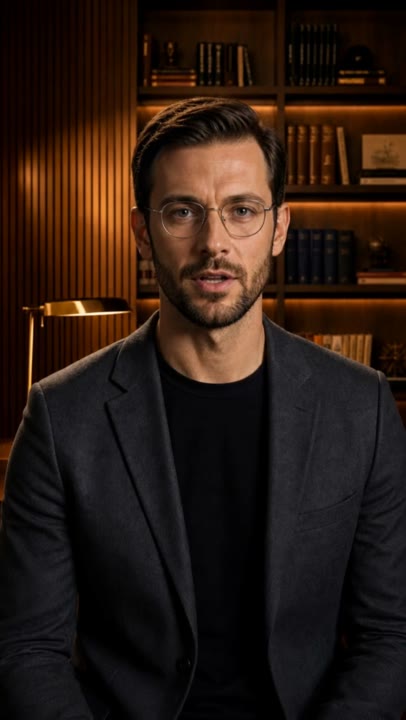
Expert Talking Head is Lollipop’s authority format. A credentialed presenter talks down the lens from a built set, lit with a soft key off axis, a fill and a rim separating them from a background that falls away. Wardrobe is tailored and plain, with no logos on it. And the camera never shakes, whips, jump cuts or snap zooms, because all four are forbidden.
When does an ad need authority instead of relatability?
Reach for this one when belief has to come from evidence and from a reason to trust whoever is speaking. The definition asks for an expert with a stake, arguing from numbers, mechanisms, studies and crew-shot proof, on a rhythm that alternates between saying and showing.
The avoid half is written just as tightly. Skip it for a product with no provable layer under it. Skip it, too, whenever the brand wants to feel scrappy and native rather than finished, because the polish is not a dial you can turn down.
That second exclusion is the whole separation from everything else in the UGC family. This is the one format whose register is written as scripted rather than conversational, and its visual rules describe it as the deliberate opposite of scrappy phone-shot footage. Every frame has to read as lit by a crew, shot on sticks and finished by a colourist. If the opposite is what you want, the Yapper format puts one person in one real room under a single practical light, which is the same person-to-camera premise with none of the finish.
Make one of these for your own product.
Make an expert spotEvery new account starts with 4,000 credits.
What has to be true of the set and the presenter?
The set is built, not found. A soft key sits off axis, a fill lifts the shadow side, and a rim separates the presenter from a background that falls off into shallow depth: an architectural wall, a lab, a workshop. Skin keeps real texture, with pores and lines visible rather than airbrushed, which is what stops the polish tipping into plastic.
Wardrobe is tailored and unwrinkled, in solid colours, or whatever coat the credential implies. No busy patterns. No visible logos, no graphic tees, no hoodie.
Only one person in the ad should be speaking
An actor who speaks runs the whole actor pipeline: a generated portrait, a preview video, a cloned voice and a video-model element. An actor who is only seen stops at the portrait. In this format that arithmetic and the creative direction point the same way, since a second voice dilutes the authority the whole thing runs on.
How does the anchor, proof, anchor rhythm work?
The presenter states a claim to camera. A crew-shot proof cutaway carries it. Then the picture returns to them and the argument moves on. Their voice does not stop for the cutaway; it runs across it, which is why the cut feels like emphasis rather than an interruption.
Two rules keep the proof honest. A proof cutaway contains no human face and no speaking mouth, so nothing in it can be mistaken for a second testimonial. And proof types escalate rather than repeating back to back, so the same kind of evidence never lands twice in a row.
Why is burned-in text allowed here and almost nowhere else?
This is the one place in Lollipop where an on-screen stat lockup is a signature rather than an exception. One number or claim is burned onto the proof shot it belongs to, never over the presenter’s face, and never more than one line at a time.
Whether an ad carries authored on-screen text is decided by the format rather than by the user. Some formats forbid overlays outright, one makes them mandatory on the hook and the CTA, and others allow a single sparse line.
Does it ever invent the evidence?
No. The scripting agent is instructed never to manufacture a number, a study, a certification or a percentage, and to build on the mechanism instead when no hard numbers exist, because a premium spot dies the instant its evidence turns out to be invented. Where the brief supplies nothing numeric, the argument is made from how the thing works.
How long is an expert spot?
Its default length is 45 seconds, and its allowed lengths are 30, 45, 60 and 90.
Scripts are written to about three spoken words per second, so a format’s length is also its word budget. This one spends that budget slowly. A composed presenter who pauses before a figure is not delivering at the top of the band, and the anchor shots are sized for that.
Where it sits among the other UGC formats
The six UGC formats separate on two mechanical questions rather than on taste: whether there is B-roll at all, and where the speech lives. Answer both and you have picked one.
| Format | Where the speech lives | Does it cut away | Authored on-screen text |
|---|---|---|---|
| Expert Talking Head | Presenter speaks, and keeps speaking over the proof | Short proof runs, bracketed by the presenter | Yes, and the format treats it as a signature |
| Yapper | Spoken in shot, and only in shot | None at all | Off, bar a single closing card |
| UGC with B-Rolls | Carried over the cutaways | Proof, as each claim is made | Sparing, on proof cutaways only |
| UGC Story | Carried over the cutaways | The same creator, living her day | Minimal, because the voice is the copy |
| UGC Voiceover | Heard, never seen leaving a mouth | The whole picture is cutaway | Essentially off |
| UGC Text & Music | There is none | No B-roll, because there is no A-roll to leave | The captions are the script |
What an authority spot costs you
- No provable layer, no format. The script will not manufacture a figure or a study to fill the proof runs, so a product whose only claim is that people like it gives this format nothing to cut to.
- The camera vocabulary is closed. Handheld shake, whip pans, jump cuts, off-level frames and snap zooms are forbidden outright. Anything that would read as native phone footage has been designed out, which is exactly what you are buying and exactly what you cannot ask for back.
- Overlays are rationed. One line at a time, on a proof shot, never across the presenter. A dense graphics package is a different kind of ad.
If polish is the wrong signal for your product
Authority is a lever, and it is not the only one. When the sell needs to look like something a real customer filmed on a phone, that is the scrappy end of the same family and Yapper locks the wardrobe, the room and the light for the whole ad to keep it there. When there is nothing worth saying out loud and the picture can carry it, the Text & Music format has no speech in it at all and puts every word on screen instead. The full library sorts into six families if neither of those is the shape you are after.
Start a Expert Talking Head ad now.
Make an expert spotDescribe the product in a chat. Lollipop writes the script, casts the actor and renders every shot, and you can open the canvas to change any of it.