Ad format
Designed characters, a modelled set, and the brand as the punchline
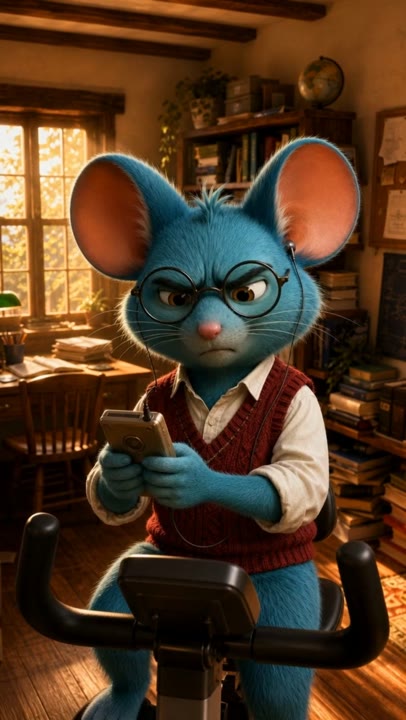
This is Lollipop’s animated character format, and every frame of it is built rather than filmed. Designed characters act on a modelled, art-directed set with one colour story held across every scene, finished like a feature film: soft global illumination, subsurface scattering, real catchlights in the eyes, a shallow cinematic depth of field. No photographic element ever enters the set.
Why would an ad be a cartoon at all?
Because some products personify. The definition asks for a shape, a job or an enemy that a character could embody, and then smuggles the brand into a story rather than pitching it, on the theory that the charm of the craft is what buys the attention in the first place.
Its avoid clause is the more useful half. Do not reach for animation when the buyer needs to see the real product in real hands, and do not reach for it when the claim depends on visible proof rather than a laugh. An animated frame cannot prove anything about a physical object, because every pixel of it was designed by somebody.
Make one of these for your own product.
Make an animated adEvery new account starts with 4,000 credits.
What does the render actually have to do?
The catalogue’s own name for it is Pixar-Style 3D Animation. Everywhere else here it is just the format, because what decides whether an ad works is the rule set rather than the label on it.
Designed 3D characters on a modelled and art-directed set, with one colour story held across every scene. That is the whole environment rule, and it forbids the two things that usually go wrong: a photographed location standing in for a designed one, and a palette that changes between cuts so the ad reads as a pile of renders rather than one short.
A character’s identity is a design spec, never a likeness. Silhouette and head-to-body proportion, eye style and size, a named palette, one surface material, the limbs and how they articulate, the costume, the render look. Written down once, and pasted back verbatim into every scene that character appears in.
How is the story shaped?
An animated ad in Lollipop is built on a four-beat mini-film arc: open inside the world mid-feeling, escalate the conflict, turn into the brand so the laugh and the sell land on the same beat, then resolve the story and make the ask in character. Never open on the brand.
Only one character speaks in any single scene, so a two-character exchange is split into two scenes. That split is not a workaround. Cutting to the reaction is usually the funnier half of the exchange, and writing towards it makes the ad better rather than longer.
How long can one of these run?
Its default length is 30 seconds, and 45 and 60 are the other allowed lengths.
The script is written to about three spoken words per second. A minute of animation is therefore a surprisingly small number of sentences, and that is the constraint which forces the format to act rather than explain.
| Format | Characters and set | How it is finished | What you give up |
|---|---|---|---|
| Pixar-Style 3D Animation | Designed 3D characters on a modelled, art-directed set | Soft global illumination and real catchlights in the eyes | No photographic element ever enters the set. |
| Felt Stop Motion | Needle-felted wool on a handmade tabletop set | Matte fabric, macro focus, a slightly stepped cadence | Everything in frame reads as a toy, product included. |
| Claymation | Sculpted plasticine with the thumbprints left in | Matte clay, with the only gloss in the eyes | The product on screen is a sculpted stand-in. |
The parts nobody puts in a brochure
- The render has no memory. Every scene in an animated ad is rendered with no memory of the one before it, so drift in a character’s design, proportion, palette, eye size or surface material between scenes is this family’s main failure mode. Asking for “the same character as before” produces a different character, which is why the rules restate the whole design on every scene.
- Dialogue has a hard ceiling. In an animated ad the characters’ voices are produced by the video model itself, and a line is capped at 4.5 spoken words a second. Past that the tail of the line is simply gone, and a punchline that got cut is worse than a punchline delivered slowly.
- Faceless characters wander. A character with a face keeps one bound voice across every scene. A character with no face, an orb, a logo, a disembodied shape, gets no bound element, so the video model reinvents its voice from the prompt on each shot. Give one of those fewer and longer speaking scenes.
- Nothing is written on screen. The format authors no text overlays at all, so every word has to survive being heard once. Brand lettering is allowed only where it has been physically modelled onto a prop in the set.
Not sure animation is what you want?
All three animated formats share the arc and the cast rules above and differ on material. For something handmade and soft, felt stop motion builds the whole world out of wool, fabric and card, and for something handmade and a little grotesque, claymation sculpts its cast in plasticine and shoots it on a tabletop. If the honest problem is that your argument needs evidence rather than a story, a whiteboard explainer draws the reasoning out one mark at a time and puts a voice behind it.
Start a character animation ad now.
Make an animated adDescribe the product in a chat. Lollipop writes the script, casts the actor and renders every shot, and you can open the canvas to change any of it.