Ad format
Wool, thread and a set that fits on a table
Felt Stop Motion is Lollipop’s needle-felted animation format. Wool characters with visible individual fibres, a fuzzy halo at the silhouette edge and stitched or bead eyes act on a handmade tabletop set built from felt, wool, fabric, card and painted foam. The whole thing is lit as a miniature and moves with the slightly stepped cadence of handmade stop motion.
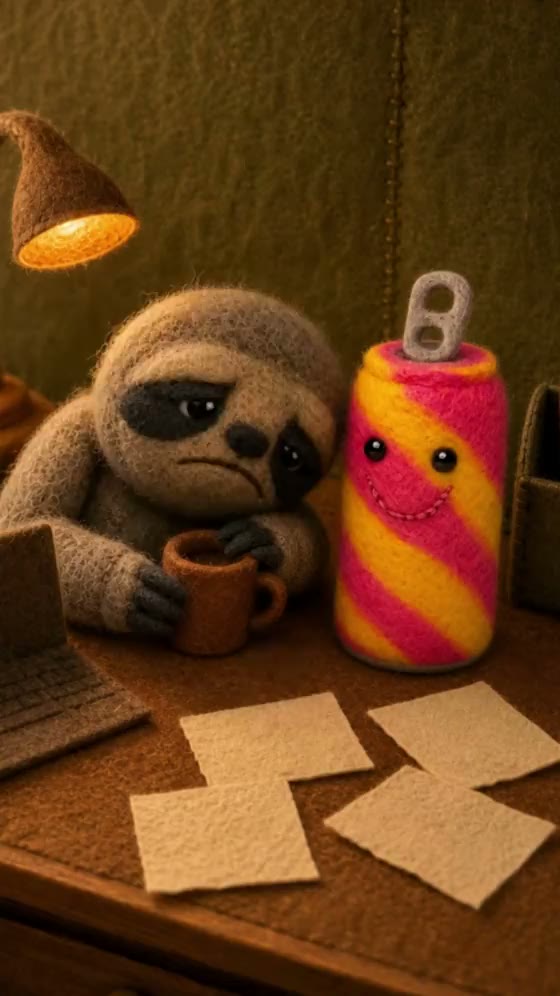
What is actually in front of the camera?
Wool, mostly. Consistency in this format is a material spec rather than a likeness, so every appearance repeats the same surface: needle-felted fibre you can pick out individually, a soft halo where the silhouette meets the background, and stitched or bead eyes carrying a real catchlight. Thread and seams stay visible. So does the dimpling the needle leaves behind.
And the negatives matter more than the positives here. The fabric is matte and light-absorbing with no specular sheen anywhere, never plastic, never the factory-perfect finish of a plush toy, never a clean vector edge. The set is held to the same standard: no smooth CG environment, no photoreal location, no flat backdrop pretending to be a room.
Which products suit wool, and which do not
The format’s own definition puts warmth and craft at the centre. Visible wool and stitched eyes read as made by hand, which is why this suits cosy, wholesome and artisanal brands, and any product gently absurd enough to personify into a character.
The avoid half is blunter. Skip it when the pitch needs technical precision, and skip it when the buyer wants a real product demo, because everything in frame is soft, fuzzy and unmistakably a toy.
Make one of these for your own product.
Make a felt animation adEvery new account starts with 4,000 credits.
| Format | What you see in close-up | What the ad is | The failure to watch for |
|---|---|---|---|
| Felt Stop Motion | Wool fibre, visible seams, a fuzzy silhouette edge | Needle-felted wool characters acting out a handmade story | Anything that looks machine-made or smooth. |
| Claymation | Matte plasticine holding thumbprints and tool marks | Sculpted plasticine characters with the tool marks left in | Symmetry, which reads back as a computer render. |
| Pixar-Style 3D Animation | Designed characters, made and lit like a film | A tiny animated film with the brand as its punchline | A stock asset that never acts. |
What decides the story before a single frame is rendered?
Each of the 21 formats ships its own scripting agent, its own scene agent and its own visual rules, and generation is bound by them. Picking felt is not choosing a skin for a generic ad, then. It sets the wool rules above running at the moment the story is written.
That story runs on a four-beat mini-film arc. Open inside the world mid-feeling, escalate the conflict, turn into the brand so the laugh and the sell land on the same beat, then resolve the story and make the ask in character. Never open on the brand.
One voice to a scene
An animated ad casts at most about four characters, with a hard ceiling of five. Only one of them speaks in any single scene, which sounds like a restriction and works as a grammar: two puppets trading a line become two scenes, and the cut to the listening face is where the joke actually lands.
How long is a felt ad, and how many words fit inside it?
The allowed lengths are 30, 45 and 60 seconds, and the default is 30.
Felt scripts are written to about three spoken words per second, which turns a length into a word budget before anybody writes a line. Puppets can carry a beat without saying anything, so a felt script usually spends less of that budget than a talking-head script would.
Where a felt ad goes wrong
- Drift between scenes. Every scene in an animated ad is rendered with no memory of the one before it, so drift in a character’s design, proportion, palette, eye size or surface material between scenes is this family’s main failure mode. The rules answer it by restating the character in full on every scene, and wool colour is the field that slips first.
- Speech has a hard ceiling. A scene’s line is capped at 4.5 spoken words a second, because past that the model drops words or cuts off the tail. The fix is a longer take rather than a faster read.
- A faceless character cannot hold one voice. An animated character with a face keeps one bound voice across every scene. A character with no face, an orb, a logo, a disembodied shape, gets no bound element, so the video model reinvents its voice from the prompt on each shot and the result is similar between scenes rather than identical.
- No authored text overlays, at all. No captions, no title cards, no lower thirds. Dialogue and lyrics live in the audio only, and brand lettering is allowed nowhere except where it has been physically built into a felt prop.
When wool is the wrong answer
Craft is the whole argument here, so the honest question is which craft. If the character wants to squash, mug and be slightly grotesque about it, claymation sculpts the same story out of plasticine and leaves the fingerprints in. If the pitch wants a modelled world and a feature-film finish rather than a tabletop, the animated format built on designed characters renders an art-directed set. And when the buyer has to watch the real thing come out of a real box, a POV unboxing puts a real package under a real pair of hands instead of a stand-in made of wool.
Start a Felt Stop Motion ad now.
Make a felt animation adDescribe the product in a chat. Lollipop writes the script, casts the actor and renders every shot, and you can open the canvas to change any of it.