Ad format
The camera is your eyes and the hands are yours
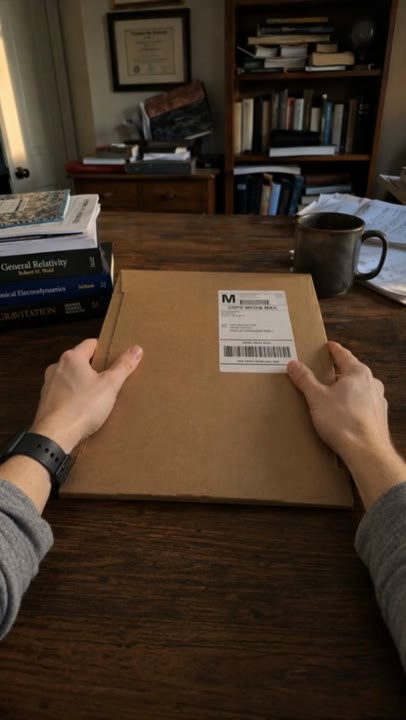
POV Unboxing is Lollipop’s silent, first-person ad format. The camera looks down at the reader’s own hands while they break the seal on a real package, and one pair of hands is the only part of any person that ever appears. The sound is the packaging. The selling happens through tactility and through the payoff when the product finally does something.
What is a POV unboxing actually showing you?
The camera looks down at the reader’s own hands from 45 to 90 degrees while they break the seal on a real package. Hands enter from the bottom or the sides of frame and work on the product where it sits, which is the small distinction that makes the format read as native rather than as a shopping channel: nothing is ever held up to the lens.
The viewer self-casts into those hands, which is why the shot never pulls back. One pair of hands is the only part of any person that ever appears, and a second pair would be a second person, which the format forbids outright.
Silent first, narrated only if you ask
The default is no voice at all. Every scene runs silent, the packaging is the audio track, and the visual direction is written richer than usual to make up for having no words to lean on. Narration exists as an option and it is off unless a brief asks for it, in which case the voice is the hand owner’s own, cloned, arriving over a frame that still holds nothing but her hands.
Make one of these for your own product.
Make an unboxing adEvery new account starts with 4,000 credits.
| Format | Who is in shot | Where the words come from | What keeps you watching |
|---|---|---|---|
| POV Unboxing | One pair of hands, working on a desk | Nothing spoken, by default | The sealed box, and what is under the lid. |
| Whiteboard Explainer | A drawing hand and forearm, nothing else | A spoken voiceover carries the argument | The race between the marker and the voice. |
| Story Slideshow | Nobody, and no face anywhere | Short captions, in plot order | A process advancing a step at a time. |
| Product Mashup | Nobody, sometimes a hand as a prop | A hook line and one-word labels | The swap, repeated until it is hypnotic. |
Why does the open get so much of the runtime?
Because the seal is the question and the product is the answer. An unboxing runs 5 to 10 shots and spends real time on the open, which may be split across two of them. It never cuts straight from a sealed box to the product in hand, and every action names the sound it makes.
That shape is also the fit test. The definition asks for real packaging and one convincing thing hands can make the product do in a couple of seconds, then tells you to avoid the format when the product is software, ships in a plain mailer, or only proves itself after weeks of use.
Nothing in the plate may show a face
An unboxing plate may contain nothing that could show a face: no mirror, no window pane facing camera, no polished chrome, no glass front, no dark screen and no glossy reflective surface. A reflected face is the same failure as a face in frame.
How much text ends up on screen?
An unboxing carries at most two lines of on-screen text and defaults to none: one hook line over the sealed box and one closing line on the resolve, in one type style, placed off the hands. No captions, no labels, no subtitles.
How long is an unboxing ad?
An unboxing defaults to 20 seconds, and the allowed lengths are 15, 20 and 30.
Picking it is not choosing a filter. Each of the 21 formats ships its own scripting agent, its own scene agent and its own visual rules, and generation is bound by them. The hands rule and the silence are therefore enforced while the plot is still being written.
What tends to go wrong
- The crop has to be described as framing, never as anatomy. A prompt that lists the parts of a person who is not in shot gets read by the image provider’s safety classifier as dismemberment content and the generation is refused outright. So the rules describe hands opening a box on a desk, seen from above, and never say what is missing. It is a real limit on how the shot can be specified, and it has already killed scenes on a sibling format built the same way.
- One person, and only one. The hands belong to a declared character whose portrait anchors skin tone, nails, knuckles and cuff across every cut. Drop that character to keep the face out and the hand is reinvented shot by shot instead.
- It cannot be rushed. The demo needs enough time to read as the product working rather than as a blur, and hard cuts are the only transition allowed. A brief that wants ten benefits covered has asked for a different format.
- There is nowhere to put a claim. With at most a hook and a closing line, an argument that needs a sentence has no surface to land on.
If there is nothing worth opening
The sealed box is the whole retention device, so a product without one is a product without this format. When the pitch is reasoning rather than tactility, the whiteboard explainer keeps the face out and puts a voice over a drawn board. When the range is the argument and one product is not, a product mashup locks one template and swaps a variable every cut. And when the thing worth watching is the process rather than the packaging, a story slideshow runs the product-in-use shots in plot order and lets short captions carry the message.
Unboxing only exists for a physical product, so the more useful next question is often what you sell rather than what you film. Which formats suit an online store shipping physical products takes that route through the catalogue.
Start a POV Unboxing ad now.
Make an unboxing adDescribe the product in a chat. Lollipop writes the script, casts the actor and renders every shot, and you can open the canvas to change any of it.