Ad format
One face, two selves, and a camera that never moves
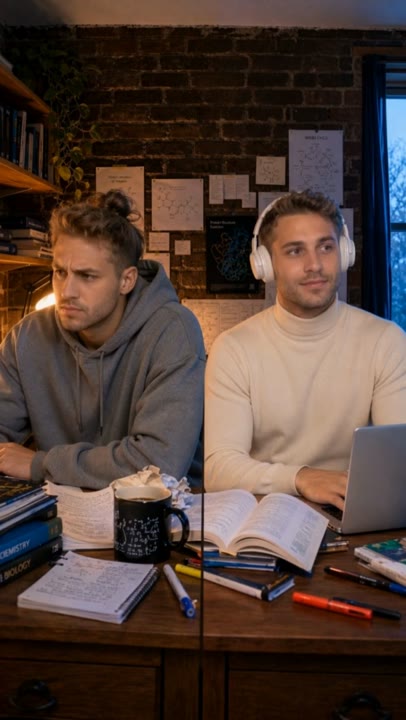
A Twin Skit is Lollipop’s sketch format in which one actor plays both sides of an argument with themselves and the product settles it. Persona A sits screen left and always looks right, persona B sits screen right and always looks left, so the reverses read as two people facing each other in one room. The camera never moves.
The test every frame has to pass
The test a Twin Skit has to pass is that a viewer pausing on any frame can tell which persona is on screen without hearing the voice. If they cannot, the differentiation has failed. Everything else in the format exists to serve that one check.
It is met with three locked packages, ranked by how much work each one does. Wardrobe first, and it has to be a different silhouette and a different colour rather than a different shirt. Hair second: up against down, a cap, glasses on or off. Posture third: sprawled and low in the seat against upright and squared. Same face, different everything else.
How many actors does a twin skit cast?
One. A Twin Skit declares exactly one character, the performer, because both twins are two performances of one person. A second declared character generates a second face and the premise dies on the first cut.
That single declaration is also the whole cast budget. An actor who speaks runs the whole actor pipeline, a generated portrait, a preview video, a cloned voice and a video-model element, while an actor who is only seen stops at the portrait. Two personas here, one pipeline.
Make one of these for your own product.
Make a twin skit adEvery new account starts with 4,000 credits.
| Format | Who is in it | Where the camera sits | The format in one line |
|---|---|---|---|
| Twin Skit | One actor, performing both personas | Locked off on every shot, never moves | One actor plays both sides of an argument with themselves, and the product is the referee. |
| Comedy Skit | Two speaking characters by default, five at most | Two or three fixed hidden-phone vantages | A short scripted sketch where the product is load-bearing, so the joke and the call to action land in the same breath. |
| FaceTime Call | Two callers, in two different rooms | Straight down the lens, both of them | Two friends on a video call, one converting the other in real time, with the viewer eavesdropping. |
Why the camera is locked off on every shot
Nearly every shot is a locked-off single, and the room is restated identically in each one: the same walls, the same furniture, the same clutter, the same mixed light. A push-in or a handheld reframe would break the match between the empty half of A’s frame and the empty half of B’s, which is the join the illusion rests on. Framing varies across the cut instead, and never twice at the same size in a row.
Paraphrase is the enemy. Restating a persona’s package in slightly different words from one scene to the next is drift, and drift renders two strangers.
Where the product comes in
As the referee. The two selves argue about something the buyer genuinely argues with themselves about, cost against comfort or discipline against craving or the old habit against the upgrade, and the product is what settles it. It arrives as an object in a persona’s hand and is named in the dialogue, never announced to camera.
None of that is a template with blanks in it. Every one of the 21 formats ships its own scripting agent, scene agent and visual rules, and generation is bound by them. Here that means the script stage hands over a complete character sheet, wardrobe and hair and vocal tic and screen side, before a single frame is described.
How long is a twin skit, and how much dialogue fits?
The Twin Skit’s default length is 30 seconds, and its allowed lengths are 30, 45 and 60.
Scripts are written to about three spoken words per second, so a format’s length is also its word budget. A twin scene eats more of it than a monologue does, because the wordless opening image and the reaction beats between volleys are real scenes with real durations and no words in them at all.
The limits
- The format authors no text overlays. Whether an ad carries authored on-screen text is decided by the format rather than by the user, and this one carries none: no title cards, no lower thirds, no closing card holding the offer. The call to action has to land inside the dialogue.
- No cutaways and no B-roll. There is one room and there are two personas in it. Nothing cuts away to the product, so a product that has to be demonstrated to be understood is in the wrong format.
- The frame cannot get tight. Each persona has to leave their half of the frame empty for the other one to be imagined into, so the big close-up is not available on demand. One close single is allowed, once, and it is spent on the biggest reaction.
- Two similar wardrobes sink the whole thing. The illusion is carried by silhouette rather than by performance, so a brief that dresses both selves in the same register produces one confused person rather than two characters.
The other sketch format, and the one that is not a sketch
The nearest thing in the library is a sketch with a real cast: the Comedy Skit runs on two speaking characters by default, with a hard ceiling of five. Reach for it when the conflict needs two genuinely different people rather than two halves of the same one. It shoots from two or three fixed hidden-phone vantages and nobody in it ever looks at the lens, which is the one habit the two sketch formats share. When the two people are not in the same place at all, the FaceTime Call format puts both callers in their own ordinary room, looking straight down the lens. All three sit in the format library, with a real generated ad against each name.
Start a Twin Skit ad now.
Make a twin skit adDescribe the product in a chat. Lollipop writes the script, casts the actor and renders every shot, and you can open the canvas to change any of it.