Ad format
A sketch where taking the product out breaks the scene
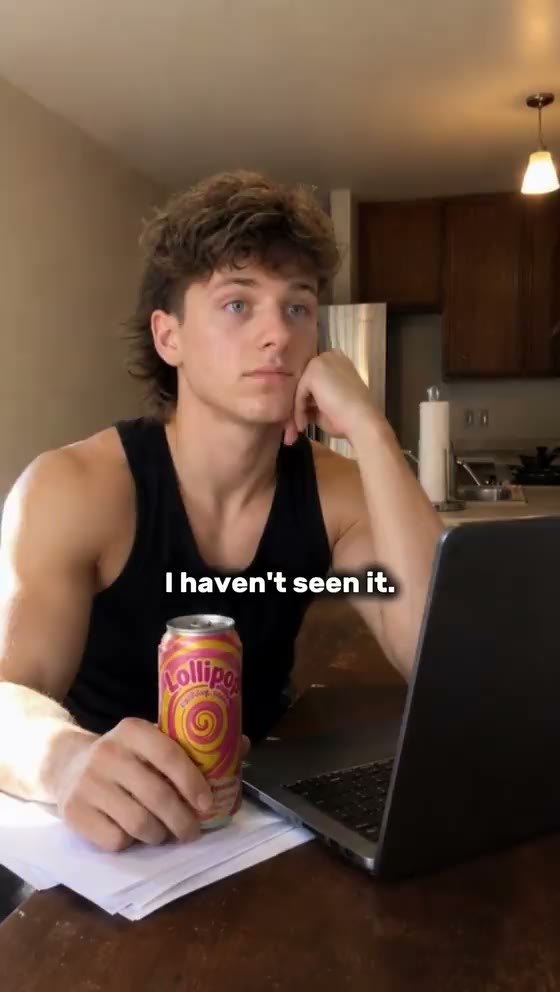
Comedy Skit is Lollipop’s scripted sketch format. A few people play a short scene in one ordinary room, filmed as though a bystander quietly caught it from across the space on a phone. Nobody ever looks at the lens, the product arrives in a character’s hand mid-conversation rather than as a prop shot, and the punchline is the widest framing in the ad.
What kind of product survives being in a joke?
The definition is specific about it. Use this format when the product sits inside a recognisable domestic or workplace conflict, something worth hiding, stealing, arguing over or getting caught with, and the selling is done by story rather than by testimony. Avoid it when the product needs demonstration or explanation to be understood, or when the brand cannot tolerate being the punchline of its own ad.
That last clause is the whole gate. In a Comedy Skit the product has to be load-bearing: take it out and the scene’s logic breaks. It enters roughly a fifth to a third of the way in rather than in the final seconds, and the last beat resolves the joke and carries the call to action as dialogue between characters.
Make one of these for your own product.
Make a Comedy Skit adEvery new account starts with 4,000 credits.
Which of the two sketch formats is this one?
Podcast and interview is one of six families in the catalogue, and it happens to hold both of the scripted comedy formats. They split on cast, and the split is total.
The Twin Skit format has one actor play both sides of an argument with themselves in one room, with the product as the referee, on a camera locked off for every shot. This one is the other answer: several people who genuinely are different people, in a room together, reacting to each other.
| Format | Who is in it | What the camera does | How the product arrives |
|---|---|---|---|
| Comedy Skit | Two or three people in one room | Two or three fixed hidden-phone vantages | Handed over mid-conversation, in character |
| Twin Skit | One actor, playing both halves | Locked off, and it never moves | The referee between the two selves |
| Podcast Clip | A host and a guest at one desk | Several fixed cameras on one sitting | Named under questioning, proved on an insert |
| FaceTime Call | Two callers in two rooms | Two phone front cameras, nothing else | Described out loud, or shown as a shared photo |
How is a skit actually shot?
The Comedy Skit format is a short scripted sketch in one lived-in room, shot from two or three fixed hidden-phone vantages that never float and never follow. The room has to look inhabited, with clutter on the surfaces and marks on the walls. A show-home or staged-catalogue room is a failure.
Vantages differ in distance, height and angle: a low wide, a level side single, a near insert. The camera holds still inside a shot and only moves on the cut, and the same two or three positions carry the whole scene, which is what makes four shots read as one room rather than four apartments.
The punchline is a framing decision before it is a writing one
The punchline shot is the widest framing in the ad, so the whole room lands the joke. Two-shots are home base and singles are punctuation, cut to only when a reaction is the shot. There are no over-shoulder framings anywhere in the format.
And nobody ever looks at the lens. Every gaze lands on another character, on the product, or on middle distance. It is the easiest rule in the format to break and the most damaging, because a single glance at camera converts a scene somebody caught into a scene somebody performed.
How big can the cast get?
A Comedy Skit’s default cast is two speaking characters, a lead and a catalyst, with a hard ceiling of five and up to two optional walk-on parts who get three to eight seconds. Past two speakers the extras stay silent, and a recurring silent character still has to be declared or the video model reinvents them between shots.
The distinction is speech, not presence. An actor who speaks runs the whole actor pipeline, a generated portrait, a preview video, a cloned voice and a video-model element, while an actor who is only seen stops at the portrait. So a roommate who freezes in a doorway and says nothing costs a fraction of one who talks. Put them in.
How long does a skit run?
A Comedy Skit defaults to 30 seconds, with 45 and 60 as its other allowed lengths.
Scripts are written to about three spoken words per second, so a format’s length is also its word budget. A skit deliberately spends less of it than it could. The reaction hold and the dead air before a punchline eat runtime while carrying no words, and that slack is what the comedy is made of.
What this format will not let you do
- There is nowhere to cut away to. No B-roll, no cutaways, no dissolves and no montage. Everything in the ad is the scene, so a demonstration you cannot stage inside the room does not happen at all.
- No authored on-screen text. The overlay field is empty on every scene of this format. The product name is spoken in dialogue rather than typed on the frame, which means a brand that needs its name legible has to earn it in a line.
- Every shot carries a line. A wordless beat is dead air deliberately left inside a spoken shot, never a shot of its own, so the held pause is bought by making a talking shot longer than its words need.
- Explanation kills it. A character reciting a spec sheet is the failure state. Details have to surface sideways, under accusation or defence, which is a real limit on how much of a product this format can teach.
Where to go if the joke is not the sell
Each of the 21 formats in Lollipop ships its own scripting agent, its own scene agent and its own visual rules, and generation is bound by them. Switching format changes the argument rather than the styling.
If the funnier version is one person arguing with themselves, the Twin Skit format casts a single actor as both halves of the argument. If the claim needs an expert to be pushed on rather than a character to be caught, the Podcast Clip format seats a host and a guest at one mic’d desk. And if the sell is really one friend talking another into it, the FaceTime Call format puts the two of them on a video call in separate rooms.
Start a Comedy Skit ad now.
Make a Comedy Skit adDescribe the product in a chat. Lollipop writes the script, casts the actor and renders every shot, and you can open the canvas to change any of it.