Ad format
Two rooms, two front cameras, and nothing to cut away to
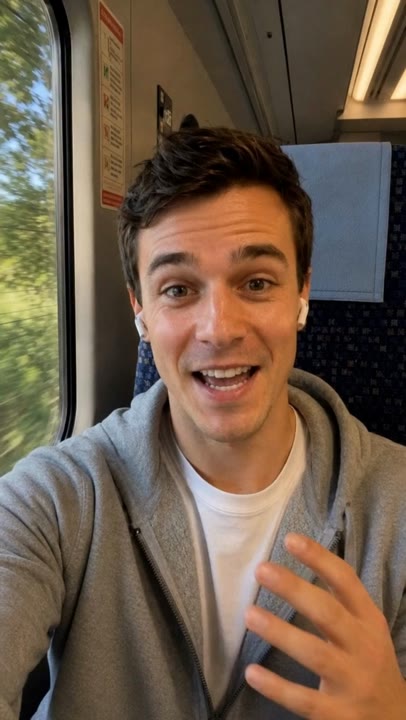
FaceTime Call is Lollipop’s video call format: two friends on a phone call in two visibly different ordinary rooms, one converting the other while the viewer eavesdrops. There is no B-roll, no demo and no cutaway anywhere in it. Both callers look straight into their own lens, and the frame holds either one of them or both, stacked.
What can a video call ad not do?
A FaceTime Call ad has no B-roll, no demo and no cutaway. Two faces carry all of it, and the only non-face picture allowed is a shared photo shown as an inset with the caller still visible.
The format says so itself, and says it as the reason to avoid it: skip this one when the product must be seen to be believed. Use it when the buyer’s real objection needs to be spoken out loud and beaten on camera, and the proof is a lived experience one friend would actually call another about.
Everything else on this page follows from that constraint. A phone call ad is an argument made entirely in dialogue, so the writing carries a load it never carries in a format with somewhere to cut.
Make one of these for your own product.
Make a video call adEvery new account starts with 4,000 credits.
Why do both callers look straight at the camera?
Both callers gaze into the lens, which is the exact opposite of every other conversational format in the library. Elsewhere a look at the lens breaks the illusion. Here it is the illusion, because a person on a call is looking at their own screen and their own camera sits right beside it.
So do not correct it. A caller with an off-lens eyeline reads as somebody being filmed by a third party, and the whole premise of eavesdropping on a private call goes with it.
Two rooms, and they have to look like two rooms
There is no shared physical location in this format. Each caller has their own small, ordinary room, locked for the whole ad and restated identically in every shot they appear in, and the two rooms must be visibly different places. A kitchen and a car. A bedroom and a desk.
The light is meant to be bad. Window light from one side, an overhead bulb, daylight through a windscreen, screen glow on a face at night, with mixed colour temperatures and blown highlights all correct. A softbox key or a ring-light halo in the eyes is the failure, because it announces that somebody lit this.
How many people can be on the call?
A FaceTime Call ad casts exactly two people, both speaking and both on camera. Never one, never three.
Both of them are the expensive kind. An actor who speaks runs the whole actor pipeline, a generated portrait, a preview video, a cloned voice and a video-model element, while an actor who is only seen stops at the portrait. A call has two ends and both ends talk, so this format pays for two of those and the platform treats it as a declared exception rather than a mistake.
The two are also meant to contrast. One leads and one resists; one gets a wider size and the other a tighter one, so a still frame alone tells you these are two different cameras rather than one set dressed twice.
How long is one of these?
The default length is 30 seconds, and the allowed lengths are 30, 45 and 60.
Scripts are written to about three spoken words per second, so a format’s length is also its word budget. A short call is not a shortened script here. It is a shorter argument, with fewer objections raised and beaten.
How does it compare with the other two-person formats?
Podcast and interview is one of six families in the catalogue, and several of its formats put two people in conversation. They are told apart by geometry: how many spaces exist, where the eyes go, and what the edit is permitted to show that is not a face.
The Twin Skit format, for instance, has one actor play both sides of an argument with themselves in one room, with the product as the referee, and the camera locked off on every shot. Same number of voices on paper. A completely different production underneath.
| Format | How many spaces | What may join the faces | How it is framed |
|---|---|---|---|
| FaceTime Call | Two, one per caller, visibly different | A shared photo, sitting over a visible face | One caller filling it, or both stacked |
| Podcast Clip | One studio, shared | Short proof inserts on the running audio | Rotating fixed cameras on one sitting |
| Twin Skit | One, and one actor in it twice | Nothing, the camera never moves | A locked-off shot, both selves placed in it |
| Street Interview | No room, one outdoor street | A product passed inside the framing | A host single, then a stranger single |
The rest of the limits
- A product shot with no face in it is not allowed. The shared picture is an inset over a caller who stays on screen behind or beside it. Nothing ever fills the frame on its own, which rules out a packshot, a screen recording and a full-frame before and after.
- No authored on-screen text. The overlay field is empty on every scene of this format. A shared photo is a picture rather than typography, so it belongs in the shot description instead.
- Framing has almost no range. The two compositions are one caller filling the frame or both stacked, and each caller keeps the same size for the whole video, so there is no wide, no extreme close-up and no push-in to lean on when a beat needs help.
- You cannot trim the cast. One speaker is not a call and three is not this format, so the two-actor build is the floor as well as the ceiling.
If two faces are not enough
A different format changes the argument the ad is allowed to make. Each of the 21 formats in Lollipop ships its own scripting agent, its own scene agent and its own visual rules, and generation is bound by them.
When the conversation should sound like an expert being questioned rather than a friend being talked round, the Podcast Clip format seats a host and a guest at one mic’d desk. When the argument only lands if the viewer watches the box actually open, the POV Unboxing format looks down at a pair of hands breaking the seal. And when one credible person could carry the whole thing alone, the Yapper format keeps that person on camera in every frame.
Start a FaceTime Call ad now.
Make a video call adDescribe the product in a chat. Lollipop writes the script, casts the actor and renders every shot, and you can open the canvas to change any of it.